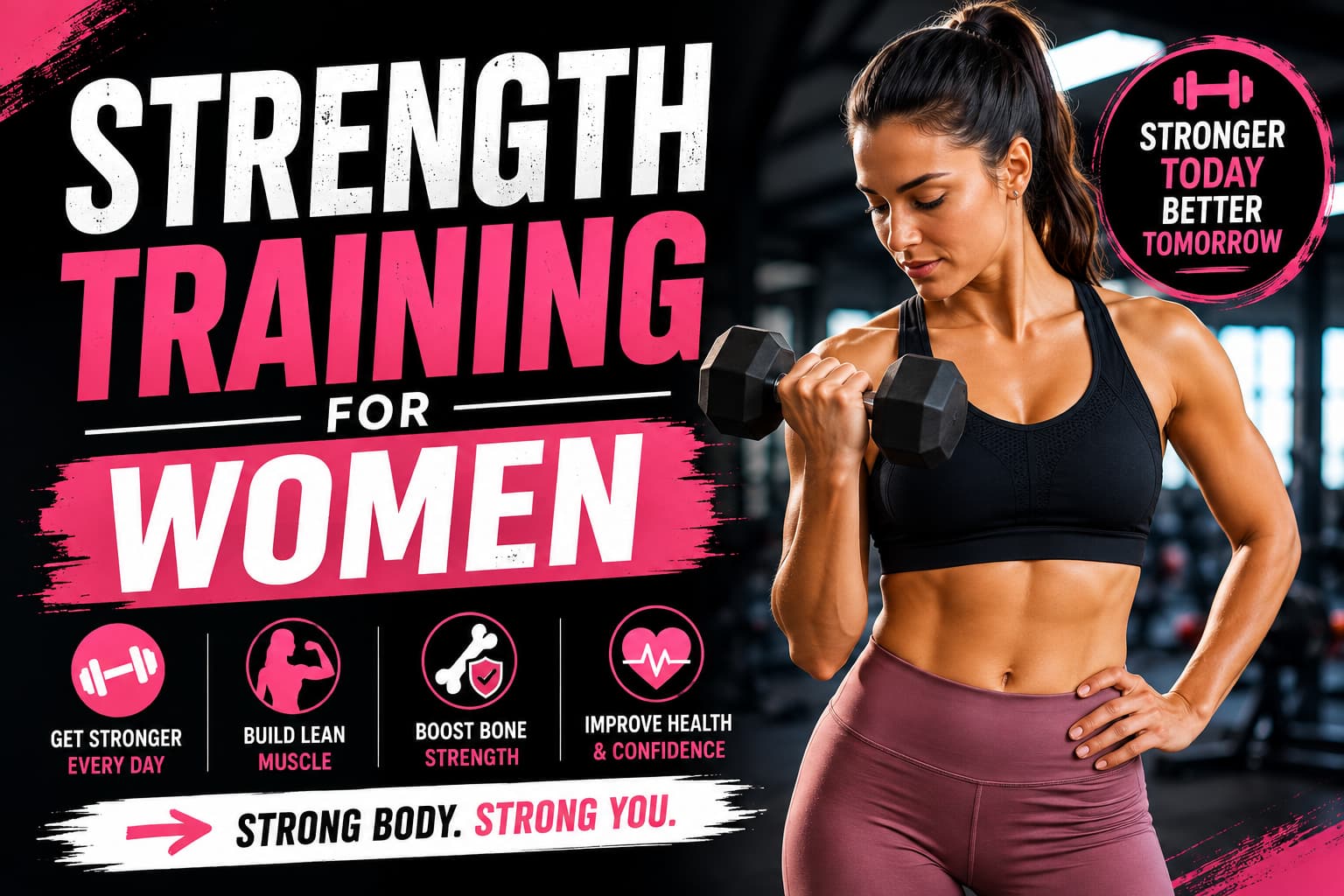
There’s still this idea floating around gyms that women should stick to the cardio machines and leave the weight rack to the guys. It’s outdated, and honestly, it’s held a lot of women back from one of the most effective things they could be doing for their bodies.
Strength training for women isn’t about turning into a bodybuilder. It’s about stronger bones, a faster metabolism, better balance, and a body that holds up well as you get older. This guide covers what actually happens when women lift weights, clears up a few myths that refuse to die, and lays out a simple plan you can start with even if you’ve never touched a barbell.
Let’s Kill the “Bulky” Myth First
This is usually the first thing that comes up, so let’s just deal with it. Women have roughly 15 to 20 times less testosterone than men, which is the hormone primarily responsible for building large amounts of muscle mass. That means the “I don’t want to get bulky” fear is, biologically, pretty unlikely to happen from a normal training routine. What actually shows up is a leaner, stronger, more capable body not the bodybuilder physique people picture.
Getting seriously bulky takes years of dedicated, heavy training, a calorie surplus, and often more than just a gym routine. A few sessions a week won’t accidentally get you there.

Why It’s Worth Doing
Beyond the myth-busting, there are real, measurable reasons strength training belongs in a woman’s routine.
It protects your bones. Bone density naturally declines with age, and the drop speeds up after menopause. Harvard Health notes that resistance exercise is one of the few things that actively stimulates bone growth, particularly in the hips, spine, and wrists the exact areas most vulnerable to fractures later in life.
It boosts your metabolism. Muscle tissue burns more calories at rest than fat does. More muscle means your body is quietly working a little harder even when you’re just sitting around.
It supports everyday strength. Carrying groceries, climbing stairs, picking up a kid, getting off the floor without struggling all of that gets easier with a stronger body, and it stays easier for longer.
It’s backed by official guidelines. The CDC recommends muscle-strengthening activity at least twice a week for all adults, covering the major muscle groups legs, hips, back, abdomen, chest, shoulders, and arms.
How to Actually Start
1. Don’t overthink the first few weeks
You don’t need a coach, a fancy program, or a gym membership on day one. Bodyweight exercises squats, lunges, push-ups, planks are a completely legitimate starting point and build real strength.
2. Learn the big movement patterns
Most useful strength work comes down to a handful of patterns: squatting, hinging (like a deadlift), pushing, pulling, and carrying something heavy. Once these feel comfortable with your bodyweight, adding dumbbells or a barbell is a natural next step.
3. Lift heavier than you think you should
Light weights with endless repetitions don’t build much strength they mostly build endurance. A weight that feels genuinely challenging by the last couple of reps is what drives real change in muscle and bone.
4. Rest between sessions
Muscles need 48 hours or so to recover and rebuild after a strength session. Training the same muscle group two days in a row usually backfires it just means you’re working tired, under-recovered muscles.
5. Track something, even loosely
Weight lifted, reps completed, how a set felt jotting down a rough log helps you see progress that’s easy to miss day-to-day. Two months in, that’s often the difference between feeling like nothing’s changing and realizing you’ve genuinely gotten stronger.
A Simple Weekly Starting Plan
Nothing complicated here three full-body sessions a week is plenty when you’re getting started.
| Day | Focus | Example Exercises | Sets x Reps |
|---|---|---|---|
| Day 1 | Lower body + core | Bodyweight squats, glute bridges, plank | 3 x 10–12 |
| Day 2 | Rest or light walk | ||
| Day 3 | Upper body + push | Push-ups (or knee push-ups), dumbbell rows | 3 x 8–10 |
| Day 4 | Rest or light walk | ||
| Day 5 | Full body | Lunges, dumbbell deadlifts, shoulder press | 3 x 10 |
| Day 6–7 | Rest / recovery | Stretching, walking |
As strength builds, you can gradually add weight, increase reps, or introduce new movements. There’s no rush to complicate this.
Common Mistakes Women Make When Starting Out
- Sticking to weights that are too light. If the last few reps of a set feel easy, the weight probably isn’t doing much.
- Skipping lower body work. Legs and glutes are some of the biggest muscle groups in the body skipping them wastes a lot of potential progress.
- Training through pain. Fatigue and mild soreness are normal. Sharp joint pain is not something to push through.
- Comparing progress to social media. Everyone’s timeline, body, and starting point are different comparison mostly just steals motivation.
- Not eating enough. Muscle needs protein and calories to rebuild. Under-eating undercuts the whole point of training.
FAQs
1. Will strength training make me look bulky? Unlikely. Women’s lower testosterone levels make significant muscle bulk difficult to achieve without years of dedicated, heavy training and specific nutrition. Most women end up leaner and more defined, not bulkier.
2. How many days a week should a beginner strength train? Two to three sessions a week, hitting the whole body each time, is enough to see real progress as a beginner.
3. Can I strength train and still lose weight? Yes in fact, it often works better than cardio alone, since more muscle mass keeps your metabolism higher even at rest.
4. Is it safe to strength train during your period? For most women, yes. Energy and strength can fluctuate across the cycle, but there’s generally no medical reason to skip training during your period unless symptoms make it uncomfortable.
5. What’s the best age to start strength training? Any age. It’s genuinely never too early or too late bone and muscle benefits apply whether you’re in your 20s or starting for the first time in your 60s.
Bottom Line
Strength training for women isn’t a trend, and it’s definitely not something to be intimidated by. It’s one of the most practical things you can do for long-term health stronger bones, a body that ages better, and a level of everyday strength that makes life genuinely easier. Start light, focus on form, and give it a few consistent weeks before judging whether it’s working. It will be.