
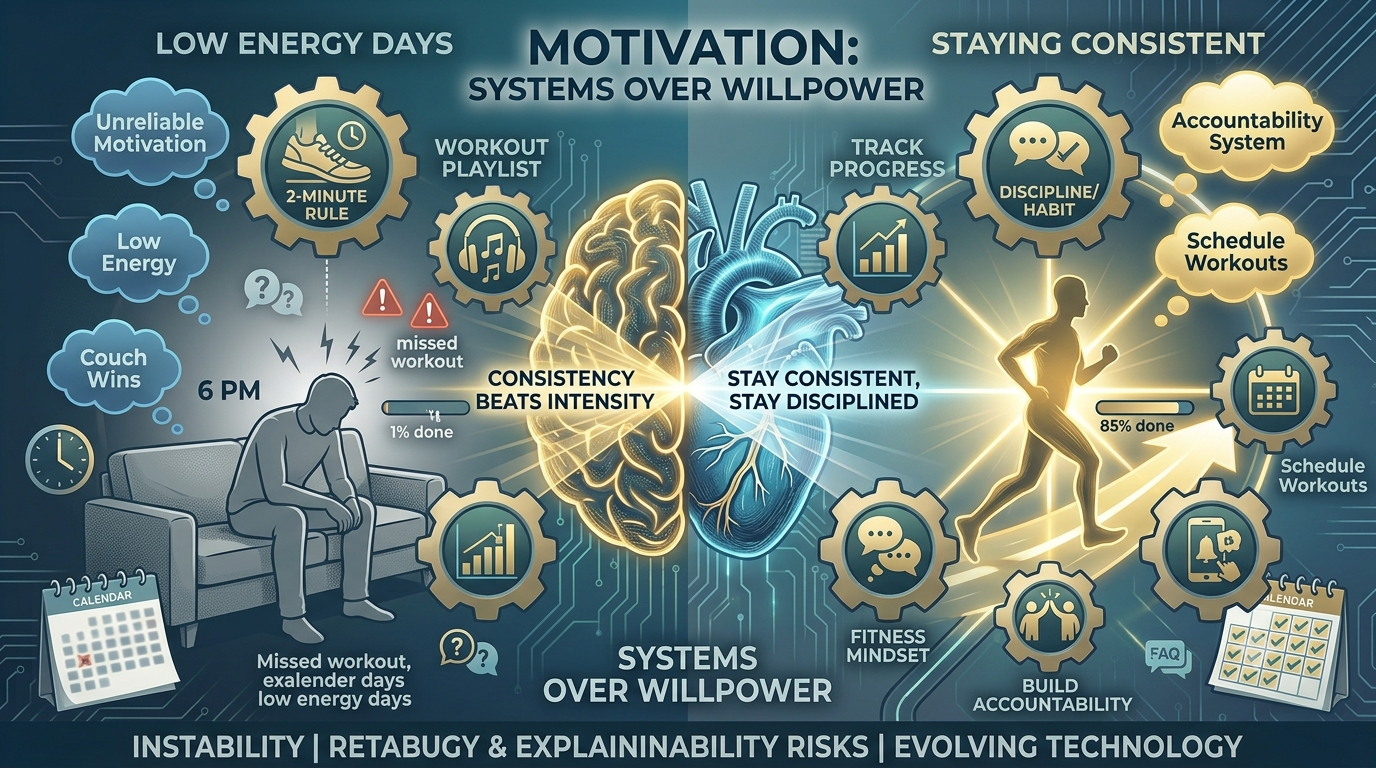
There’s this specific kind of dread that hits around 6 PM when you know you’re supposed to work out, and every cell in your body is voting no. The couch looks great. The gym bag’s sitting right there, untouched. Sound familiar?
Here’s the thing nobody really tells you upfront — motivation is unreliable. It shows up some days, vanishes on others, and building your entire fitness routine around waiting for it to appear is honestly a losing strategy. The people who stay consistent aren’t more motivated than you. They’ve just stopped relying on motivation in the first place.
So let’s talk about what actually works when your brain’s screaming at you to skip leg day for the third week running.
Why Motivation Alone Was Always Going to Fail You
Motivation is basically a mood. It comes and goes based on sleep, stress, how your day went, and random stuff that has nothing to do with fitness at all. Building a workout habit on top of something this unstable is like building a house on sand and being surprised when it shifts.
What actually works long-term is discipline, or maybe just routine, depending on how you want to phrase it. The version of you that shows up to the gym at 6 AM on a Tuesday you don’t remember deciding to go to — that’s not motivation. That’s just what you do now, because you’ve done it enough times that it stopped requiring a decision.
This is genuinely good news, by the way. It means you don’t need to feel pumped up every day. You just need a system that doesn’t depend on feeling anything in particular.
Workout Motivation Hacks That Actually Move the Needle
Some workout motivation hacks get repeated so often they’ve lost all meaning — “just visualize your goals,” sure, thanks. Here’s stuff that’s actually useful instead.
The two-minute rule works shockingly well. Tell yourself you’ll do two minutes, that’s it, full permission to quit after. Most days, once you’re moving, you keep going anyway. The hardest part was never the workout — it was putting your shoes on.
Music matters more than people give it credit for. A specific playlist saved just for workouts creates a weird Pavlovian thing where your brain starts associating those songs with movement, almost automatically.
Lowering the bar on bad days helps too. A rough fifteen-minute session still counts. It keeps the habit alive even when your energy’s tanked, which matters more long-term than any single “perfect” workout ever will.
Workout Motivation Hacks for Low Energy Days Specifically
Low-energy days deserve their own approach, because pretending you’ll perform like it’s a good day just sets you up for disappointment. Workout motivation hacks for low-energy days work differently than your usual tricks.
Swap intensity for consistency on these days. A slow walk still counts as movement. Gentle stretching counts. The goal isn’t crushing a personal record — it’s just not breaking the streak entirely.
Sometimes the fix is environmental, not mental. Change your workout time, switch locations, do something different from your usual routine. Low energy sometimes signals boredom dressed up as fatigue, not actual physical exhaustion.
Tips for Staying Consistent With Fitness Goals
Consistency beats intensity, full stop. These tips for staying consistent with fitness goals focus on systems over willpower, because willpower runs out fast and systems don’t.
Schedule workouts like actual appointments, not vague intentions floating around your week. “I’ll work out sometime Tuesday” rarely survives contact with an actual Tuesday. A specific time slot, locked into your calendar, survives way better.
Track something, anything. Workouts completed, weight lifted, minutes moved, doesn’t matter much which one. Visible progress, even tiny progress, keeps people going longer than vague hope that things are improving in the background.
Fitness Mindset Tips That Quietly Change Everything
A lot of these fitness mindset tips come down to reframing how you talk to yourself, which sounds soft until you try it and notice the difference.
Stop treating missed workouts as failures. One skipped day isn’t the end of anything — it’s just a skipped day. The all-or-nothing mindset is what actually kills most fitness routines, not the missed sessions themselves.
Separate identity from performance, too. You’re “someone who works out,” even on the days you don’t crush it. That identity shift matters more than any specific session ever will.
How to Build an Exercise Accountability System
An exercise accountability system removes the option to quietly bail without anyone noticing, which is honestly half the battle for most people.
Workout buddies work for obvious reasons — showing up matters more when someone’s waiting on you. Apps that track streaks tap into the same psychology, just without needing another human involved. Even posting your workouts publicly creates a weird social pressure that makes skipping feel more costly than it used to.
Exercise accountability tips don’t need to be elaborate. Sometimes it’s as simple as texting a friend “going to the gym” before you leave, just enough friction that backing out feels harder than following through.
Conclusion
Staying motivated forever just isn’t realistic, and chasing that feeling is setting yourself up to fail eventually. What actually works is building systems, habits, and accountability that don’t crumble the moment motivation disappears, because it will disappear, repeatedly, probably this week even. Use these fitness motivation tips not as a one-time fix but as ongoing tools, and consistency stops depending on how you happen to feel on any given Tuesday.
FAQs
1. What’s the fastest way to get motivated before a workout? The two-minute rule works well — commit to just two minutes with full permission to stop after. Usually, once you’re moving, you keep going anyway.
2. How do I stay consistent when I genuinely have no energy? Lower the intensity instead of skipping entirely. A short walk or light stretch still keeps the habit alive without forcing your body past actual fatigue.
3. Does accountability really make a difference for working out? Yes, quite a bit. Having someone expect you to show up, even informally, makes quitting feel more costly, which keeps a lot of people consistent long-term.
4. Is it normal to lose motivation even after months of working out? Completely normal. Motivation naturally fluctuates for everyone, which is exactly why relying on habits and systems matters more than chasing a feeling.
5. What should I do after missing several workouts in a row? Just restart without overthinking it. One missed week doesn’t erase progress, and treating it as a fresh restart beats spiraling into guilt that delays coming back even longer.