
Walking into a gym weight room for the first time is genuinely intimidating. There is clanging iron everywhere, massive mirrors on every wall, and people casually lifting things that look heavier than your refrigerator. Most beginners take one look and quietly retreat to the treadmill where it feels safe.
Totally understandable. But also — kind of a mistake.
If your actual goal is to feel stronger, burn fat, and build a body that works better, cardio alone will not get you there. You need strength training. And no, that does not mean you are signing up to become a bodybuilder. It just means you are finally giving your muscles a reason to grow.
Why Strength Training Is Worth Your Time
Most people think about exercise in terms of calories burned during the workout. Cardio wins on that front, sure. But strength training has a trick cardio cannot match — the afterburn effect.
When you challenge your muscles with weights, your body spends the next 24 to 48 hours repairing those muscle fibers. That repair process burns calories. So you are torching energy while watching TV, sleeping, or doing nothing. Nobody talks about that part enough.
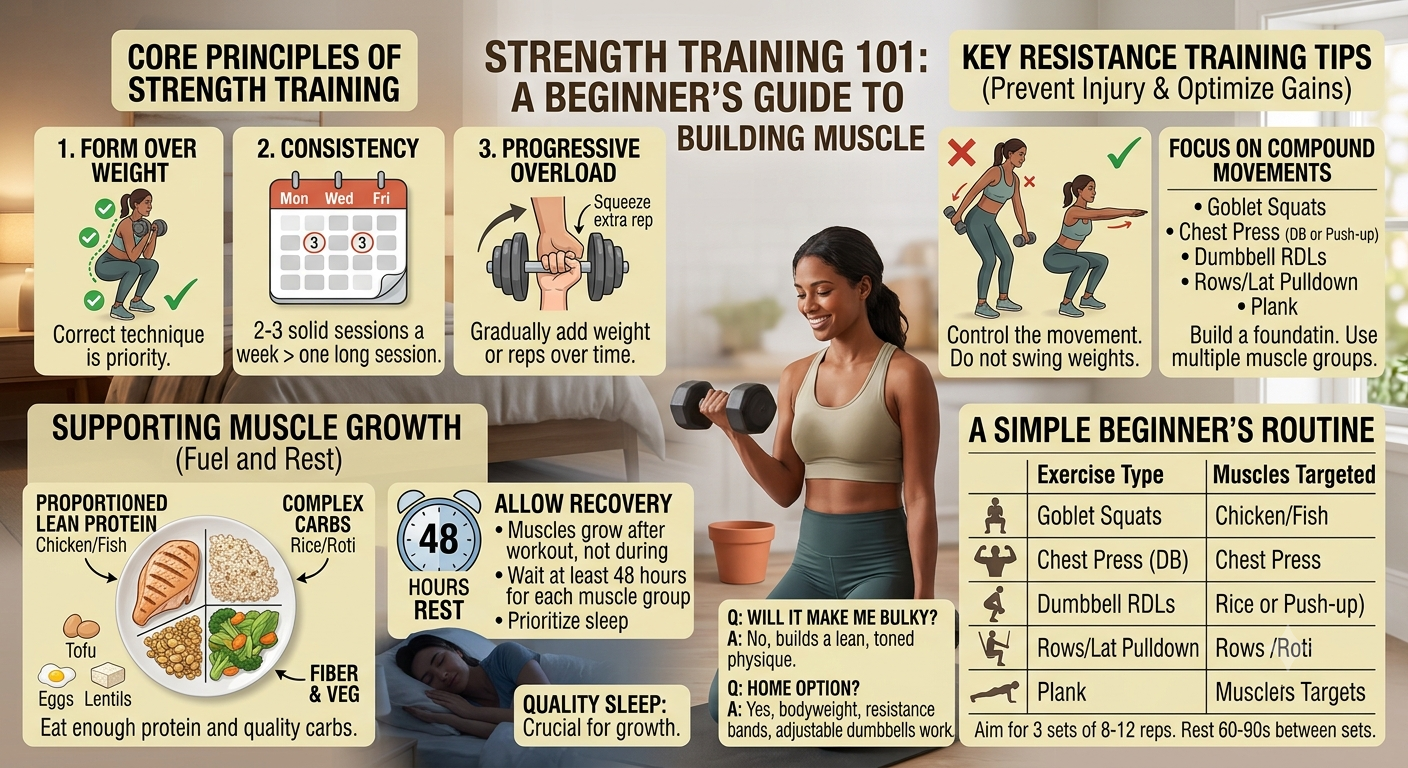
The muscle-building basics really come down to three things:
- Form over weight — how you do the exercise matters more than how much you lift
- Consistency — two or three sessions a week will beat one random three-hour session every time
- Progressive overload — slowly making things harder over time, whether that is adding a little weight or squeezing out one extra rep
Nail these three, and everything else follows.
Key Resistance Training Tips Before You Touch a Dumbbell
There is a right way and a wrong way to start. These resistance training tips will save you from the most common beginner mistakes — and from the injuries that come with them.
Focus on Compound Movements First
Forget the fancy isolation exercises you see people doing on Instagram. As a beginner, the biggest gains come from movements that use multiple muscle groups at once — squats, chest presses, rows, and overhead presses. These are the best resistance training tips for muscle gain because they build a solid foundation across your whole body, not just one tiny muscle.
Control the Weight — Do Not Swing It
If you need momentum to lift something, it is too heavy. Simple as that. Drop the weight down and move with intention — two seconds to lift, two to three seconds to lower. That slower lowering phase, called the eccentric, is actually where a lot of muscle growth happens. Most beginners rush right through it without realizing they are leaving results on the table.
Recovery Is Not Optional
Muscles do not grow during the workout. They grow afterward, while you are resting and sleeping. Train the same muscle group two days in a row, and you are just breaking down tissue that has not had a chance to rebuild yet. Give each muscle group at least 48 hours before hitting it again.
A Simple Strength Training Routine for Beginners
You do not need a complicated six-day program. A full-body routine three days a week — Monday, Wednesday, Friday works perfectly and is genuinely all you need when you are starting out. Aim for 3 sets of 8 to 12 reps per exercise with about 60 to 90 seconds of rest between sets.
| Exercise Type | Beginner Option | Muscles Targeted |
| Lower Body (Quad) | Goblet Squat | Quads, Glutes, Core |
| Upper Body Push | Dumbbell Press or Push-ups | Chest, Shoulders, Triceps |
| Lower Body (Hinge) | Dumbbell Romanian Deadlift | Hamstrings, Glutes, Lower Back |
| Upper Body Pull | Single-Arm Row or Lat Pulldown | Back, Biceps |
| Core | Forearm Plank (30–45 sec) | Abs, Deep Core |
This simple strength training routine for beginners hits everything without overwhelming you. Once it starts feeling easy — and it will — that is your signal to add a little weight or an extra rep. That is progressive overload in action.
Frequently Asked Questions
Q: Will lifting weights make me look bulky? Almost certainly not. Building significant bulk requires years of very specific heavy training, a large calorie surplus, and a lot of testosterone. For most people, strength training just builds a leaner, firmer physique while reducing body fat. It is actually one of the better tools for looking more toned, not less.
Q: How do I know if the weight I am using is right? A good rule: the last two or three reps of your set should feel genuinely challenging, but your form should still hold. If you hit rep 12 and feel like you could do ten more, go heavier. If your form breaks down by rep five, go lighter. That middle ground is where progress happens.
Q: Can I do this at home without any equipment? Yes, especially at the start. Push-ups, bodyweight squats, lunges, and planks are all legitimate exercises that build a real foundation. A set of resistance bands or a pair of adjustable dumbbells can extend that quite a bit once bodyweight alone stops being challenging enough. This is exactly what how to start strength training as a beginner looks like for a lot of people.
Q: What should I eat to support muscle growth? Protein is the big one — chicken, eggs, fish, lentils, tofu, beef. Get a solid source at every meal. Do not skip carbohydrates either; they fuel your workouts and help with recovery. You do not need a perfect diet, but you do need enough food. Undereating while trying to build muscle is a frustrating dead end.
Q: How long before I actually see results? You will probably feel stronger within the first couple of weeks — that part happens faster than most people expect. Visible changes in muscle definition usually take four to six weeks of consistent training to show up. Stay patient. The progress is happening even when you cannot see it yet.
Conclusion
A beginner’s guide to building muscle safely does not need to be complicated. Pick a simple routine, focus on learning the movements properly, show up consistently, and give your body enough food and rest to actually adapt.
Everyone in that weight room started exactly where you are right now — unsure, a little lost, wondering if they were doing it right. The only difference between them and you is time and repetition. Take it one set at a time, add a little weight when things get easy, and trust that the process works. Because it does.